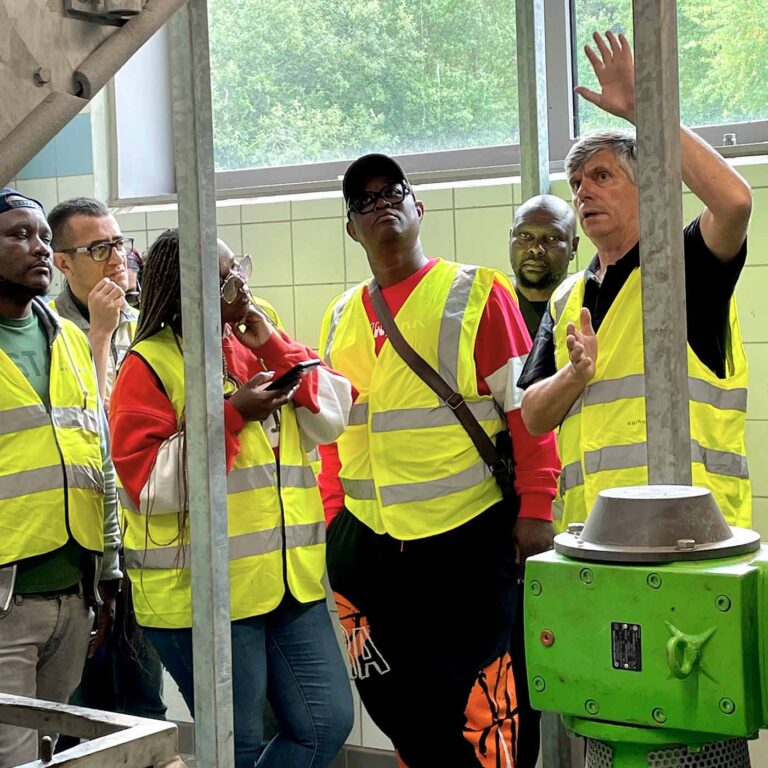
In 2025, 25 journalists from Brazil, India, Kenya, and South Africa joined our learning programme. During the group’s participation at COP30 in Belém, Brazil, four of the journalists interviewed Ole Emmik Sørensen, Head of Global Cooperation at the Danish Energy Agency, about Denmark’s renewable energy transition.
By Vibeke Quaade
Denmark has long been a frontrunner in the global shift to renewables. Wind and solar supply a substantial share of the country’s electricity mix.
The opening question came from South Africa’s Semeyi Zake, head of channel at Business Day TV: “What made it possible?”
“There wasn’t just one silver bullet,” Sørensen replied. “Part of the explanation is political ambition combined with a clear understanding of the economic benefits.”
For Dennis Aseto, journalist at KTN News Kenya, this resonated instantly. “Our challenge is not our ambitions, it is managing variability.”
“Most of Denmark’s electricity comes from wind and solar. When Denmark produces more than it needs, electricity flows to Norway. When the wind drops, Norway returns electricity to Denmark.”
Watch International Roundup, KTN News Kenya
“These interconnectors reduce costs, stabilise national grids and make renewables a shared challenge rather than one to be dealt with alone.”
“Denmark’s wind industry currently creates jobs for around 90,000 people – roughly three percent of Denmark’s entire workforce. None of this was accidental. Technology alone doesn’t make energy flow, people do.”
Nick Hedley, founding editor of The Progress Playbook: “How does Denmark collaborate with countries outside Europe?”
“Denmark works directly with governments in 14 developing countries and 7 OECD countries. We see capacity development as a means of making each other stronger.”
“Danida Fellowship Centre’s learning activities are hugely important in the sector cooperation we have on energy with your countries,” Sørensen told the four journalists.
Nicola Pamplona, reporter from Folha de S.Paulo, asked whether Denmark had specific lessons for others.
Sørensen’s message was clear: success depends on political ambitions, technology, policy, people and collaboration. But, above all, on implementation and the willingness to make it both reliable and flexible.