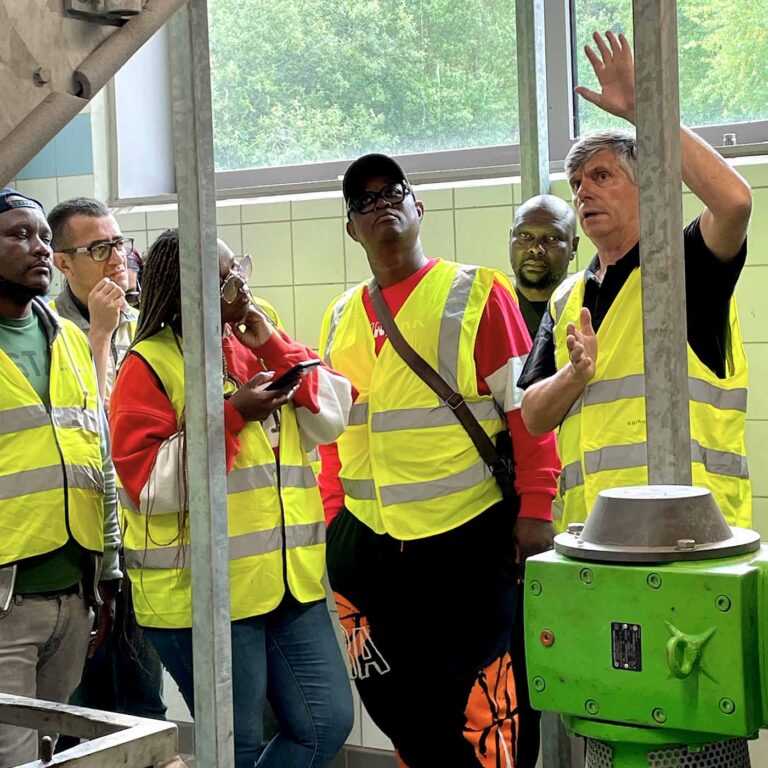
How can a city grow and - at the same time - become more resilient to climate change ? For three weeks, 27 urban planners, engineers and environmental specialists from Angola, Liberia, Nigeria, South Africa, Senegal and Togo explored that question in Denmark.
In 2019, the African Development Bank set up the Urban and Municipal Development Fund (UMDF) to help African cities manage rapid growth. Denmark supports the fund through the Ministry of Foreign Affairs of Denmark, and Danida Fellowship Centre has a three-year agreement with UMDF to train urban practitioners.
In October 2025, the first cohort of African urban practitioners came to Denmark to participate in a Sustainable Urban Development and Resilience course delivered by Roskilde University and University of Southern Denmark. The second cohort followed in April this year to attend a Solid Waste Management course delivered by DTU Sustain. The course for the third cohort, Sustainable and Climate-Resilient Urban Water Cycle Management, focused on water management and climate resilience in growing coastal cities and was delivered by DHI.
The urban water cycle
From 29 September to 15 October 2026, the participants followed the urban water cycle from source to sea. This included water resources and flood forecasting, water supply, drainage and cloudbursts, wastewater, water quality and, finally, the governance and financing that hold it all together. The participants have now gone home, each with an action plan for their own organisation, and through online consultations, DHI will be following up on their progress.
Read about the participants' expectations on LinkedIn
Learning outside the classroom
On a field visit to Denmark’s largest wastewater utility BIOFOS, the group saw how Lynetten Wastewater Treatment Plant turns wastewater from the homes of 1.7 million residents in greater Copenhagen into a resource – and does so profitably. On a canal tour, they learned how Copenhagen prepares for cloudbursts and rising seas. Examples included Ofelia Plads’ Kissing Steps, which hide a reservoir for up to 9 million litres of rainwater, and Sankt Annæ Plads, a beautiful area in the heart of the city where residents meet and relax, while beneath its surface, cloudburst water is safely channelled into the harbour.
Read about the field visit around Copenhagen Harbour on LinkedIn
What Denmark gains
Climate change is a shared global challenge, and there is much to learn from how different parts of the world address its impact. For Denmark and its partners in Africa, the exchange of knowledge can pave the way for future collaboration.
“Learning goes both ways. Rising sea levels are a global challenge, and like our partner countries in Africa, Denmark faces coastal challenges of its own. Every training course cohort builds up a network of African practitioners who know Danish solutions first-hand. It is a foundation for future cooperation with the Danish water sector, both public and private,” says Peter B. Jensen, senior specialist, Green Diplomacy and Climate, Ministry of Foreign Affairs of Denmark.
Watch the participants share what they take home:
Titilola Bright-Oridami, Head of Transformation and Strategy, Lagos Water Corporation, Nigeria
Philiswa Mhambi, Municipal Water and Sanitation, South Africa
Joana Abilio Cangolo, Junior Environmental Specialist, Angola
Moses N. Freeman, Environmental Engineer, Liberia
Salla Dieng, Municipality of Dakar, Senegal
Rashid Barry, Hydrogeologist, Togo